
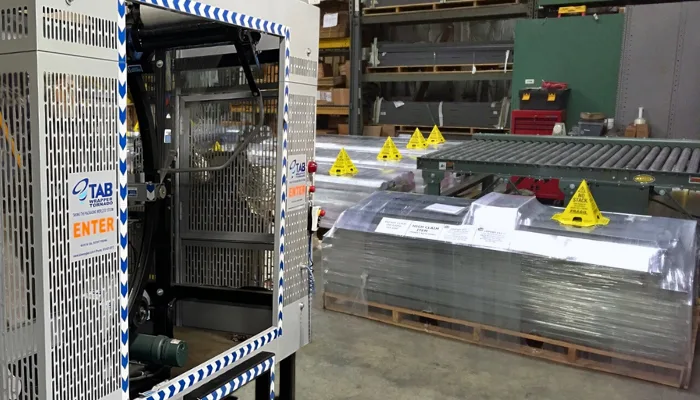
In the building industry, the last mile is often the most dangerous. From unwieldy door frames to bundled tubes, construction materials present unique transportation challenges. Securing several thousand pounds of long, irregular, and awkward shapes with traditional methods like standard vertical pallet wrapping or plastic banding doesn’t cut it. These methods often fail to provide the level of stability needed for high-stakes loads. Moving construction materials from the warehouse to the final destination requires a better method: total unitization.
Geometries of Danger: Why Standard Wrapping Falls Short
The primary goal of any transit packaging is to ensure the load and the pallet move as a single, cohesive unit. But with construction materials, standard turntable wrapping often leaves a weak link at the base. Consider a tall, heavy stack of pavers or buckets of drywall spackle stacked high on a pallet. When wrapped vertically, the film is primarily applied to the sides. If the truck driver is forced to brake suddenly or take a sharp turn, the lateral G-forces can cause the product to shear or slide right off the pallet. This is also true for items like door frames or millwork that have smooth surfaces and little natural friction to keep them in place. Traditional banding, while strong, is equally unforgiving. If a load of lumber shifts even a fraction of an inch during transport, the bands can snap or become loose, rendering them useless. When tension is lost, the load is free to tilt, creating a massive safety hazard.
360º Safety With Orbital Wrapping
Orbital stretch wrapping can completely change the equation. Unlike vertical wrappers, orbital wrappers like the TAB Wrapper Tornado apply stretch film horizontally around the entire length of the product as it passes through a rotating ring. By wrapping orbitally—meaning over the top and, crucially, underneath the pallet deck—the machine effectively locks the product directly to the pallet. This creates a unitized load where the product and the pallet are no longer two separate pieces, but one solid block.
Key Benefits of Orbital Stretch Wrapping
One of the most significant safety advantages of the TAB Wrapper Tornado is its ability to apply even tension distribution. Because the film is applied with controlled, consistent tension as the orbital ring rotates, the force is spread across the entire length of the load. Here are a few benefits:
- Prevents warping: For items like aluminum trim or PVC pipe, concentrated pressure from a strap can cause bending or permanent deformation. The TAB Wrapper stabilizes the load without the “crush” points associated with banding.
- Progressive containment: Multiple overlapping layers of film create a reinforced shell. Each layer builds upon the last, increasing stability gradually rather than relying on a single high-pressure point. TAB Wrapper Tornado operators are able to adjust the overlap percentage on our fully automated conveyorized systems.
- Stabilizes irregular shapes: Bundles of lumber or pipes often have gaps or uneven edges. Orbital stretch film compresses these items gently together from the sides, stabilizing the shape without crushing the materials.
- Protects surfaces and edges: Products like finished doors, windows, and coated metal parts have surfaces that can easily be scratched. Orbital wrapping can combine stretch film with protective materials such as foam, paper, or bubble wrap, creating a protective barrier while still securing the bundle.
- Reduces packaging material: Because the film is pre-stretched and applied efficiently, orbital wrapping uses less material while still maintaining strong load containment.
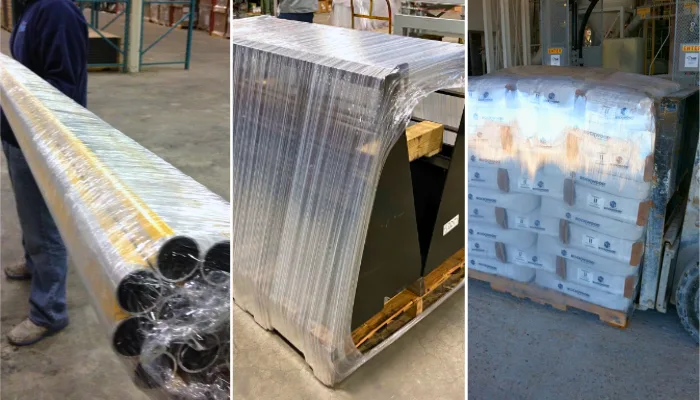 The ability to use tinted or color-coded stretch wrap is another advantage of the TAB Wrapper Tornado. In the chaos of a large-scale construction site, multiple vendors often drop off dozens of pallets simultaneously. By using color-coded film, suppliers can help onsite crews quickly identify the correct materials for specific building zones. This reduces unnecessary handling, prevents workers from opening the wrong materials, and keeps the jobsite organized and safe.
Zero Delivery Rejections
Pitt Meadows Plumbing had invested in advanced technology across their operations, but was still wrapping more than 1,500 pallets by hand per year—a labor-intensive process that required three people, frequently led to rewrapping before shipment, and cost $2,000 per rejected load. By switching to the TAB Wrapper Tornado, Pitt Meadows saw:
- Zero delivery rejections at job sites
- Improved worker safety
- Increased capacity to handle growing demand
Inventory manager Andrea Wilson shared, “We are sending out secure loads every time. Now we stay on schedule, meet deadlines without scrambling, and can handle growth without extra hiring.”
Match the Method to the Material
Ultimately, safety in transit is about matching the wrapping method to the load profile. While traditional turntable wrappers can work for standard, boxed goods, the unique demands of the construction industry require a more robust, specialized approach. The TAB Wrapper Tornado doesn’t just “wrap” a pallet; it secures a reputation. By eliminating the risks of load shifting, telescoping, and surface damage, construction suppliers can ensure their materials arrive in pristine condition. Ready to protect your materials and your bottom line? See the TAB Wrapper Tornado in action.