
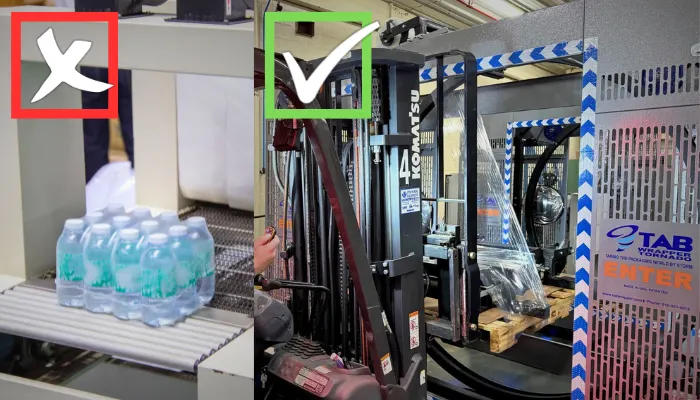
In the packaging world, the words “stretch wrapper” and “shrink wrapper” are used interchangeably. But these two technologies are fundamentally different: one relies on tension and cling, the other on heat and contraction.
Getting the terminology right matters whether you’re spec’ing a new line, writing a purchase order, or simply explaining to a client what your machine actually does. In this guide, we’ll explain all the major wrapper types, how they work, and the correct names to use.
Stretch Wrap vs. Shrink Wrap
Confusion around shrink and stretch wrap is understandable; both are plastic films that hold items together. Let’s take a closer look at the differences before diving into machine types.
Stretch Wrap
Stretch wrap is a highly elastic polyethylene film that works by being stretched under tension around a load. As the film tries to return to its original shape, it creates powerful containment force — no heat required. Stretch film is the dominant pallet-securing material in warehousing and distribution worldwide.
All TAB Wrapper Tornado models use stretch film. We’ve even developed our own line of stretch wrap in multiple colors.
Shrink Wrap
Shrink wrap is a plastic film that is loosely draped over a product. The film is then heat-activated, usually with a heat gun or heat tunnel, until it conforms tightly to the item’s shape. Shrink wrap is commonly used in retail packaging, food, and consumer goods.
Understanding Different Wrapper Types
There are several types of wrapping machines. Here’s a quick breakdown.
Orbital Stretch Wrapper
In an orbital stretch wrapper, the pallet load remains completely stationary, typically delivered by forklift or conveyor into the wrapping zone. A powered ring or arm carrying a stretch film roll then rotates in an orbital path: around all four sides of the load and underneath the pallet base. This means the stretch film encircles both the product and the pallet in a continuous wrap, physically bonding the load to the pallet deck.
The result is exceptional load stability — the product cannot shift or slide off the pallet, even under dynamic transit forces. Because the product never rotates, orbital wrappers are also ideal for loads that cannot be safely spun: extra-tall loads, very heavy loads, fragile or top-heavy configurations, and awkward shapes.
At TAB Wrapper, we offer multiple orbital wrapper configurations:
- TAB Wrapper Tornado – Standard
- TAB Wrapper Lightning (compact model for unpalletized products)
- TAB Wrapper Tornado – Dual Dispensing
- TAB Wrapper Tornado Perfect Storm (conveyorized model)
- TAB Wrapper Tornado Genius Controls
- TAB Wrapper Tornado Smart Controls
- TAB Wrapper Tornado Box Wrapper
Box Wrapper
A box wrapper applies film around cartons, boxes, or case lots rather than full pallets. Stretch-based box wrappers like our TAB Wrapper Tornado Box Wrapper bundle, and secure packages for shipping without palletizing. This type of wrapper is ideal for items that manual wrapping methods struggle with.
Turntable Stretch Wrapper
With a turntable wrapper, the pallet is placed on a rotating circular platform (the turntable), which spins while a stretch film carriage moves up and down a mast to wrap all four sides. For tall, light, or oddly shaped loads, spinning the pallet can be risky. Centrifugal force can cause products to shift or tip before the film even touches them. Because of this, turntable wrappers are best suited for stable, uniformly stacked pallets at low to medium throughput.
Rotary Tower/Arm Wrapper
A rotary tower or rotary arm wrapper functions similarly to a turntable wrapper and works well with unstable loads. However, rather than spinning the pallet on a platform, the stretch film carriage rotates around a stationary load on an arm or tower. This eliminates the centrifugal force risk associated with turntable wrappers while still supporting stable, uniformly stacked pallet loads.
Rotary Ring Wrapper
A rotary ring wrapper uses a powered ring carrying the stretch film roll that rotates around a stationary pallet load. Like orbital wrappers, the load itself remains in place while the film is applied, making this style suitable for a wide variety of load types.
Shrink Wrapper
A shrink wrapper uses heat to contract polyolefin or PVC film tightly around individual products or multi-packs. The film is first loosely draped or sealed around the item, then passed through a heat tunnel, which causes the film to shrink and conform to the product’s contours. Shrink wrappers are also referred to as heat shrink machines or sleeve sealers.
Hand Wrapper/Manual Wrapper
Hand wrapping is the simplest form of stretch wrapping, in which an individual manually walks around a pallet, dispensing film by hand without a machine. This wrapping method is labor-intensive and less secure than machine wrapping. It also carries a higher risk of employee injury from repetitive bending, twisting, and cutting, which can lead to higher workers’ comp claims for your business.
Which Wrapper is Right for You?
The right wrapping machine depends on your load size, throughput, product type, and available space. The terminology above is a great starting point for understanding your options. Learn more about the differences between TAB Wrapper models in this guide or contact us with questions.