
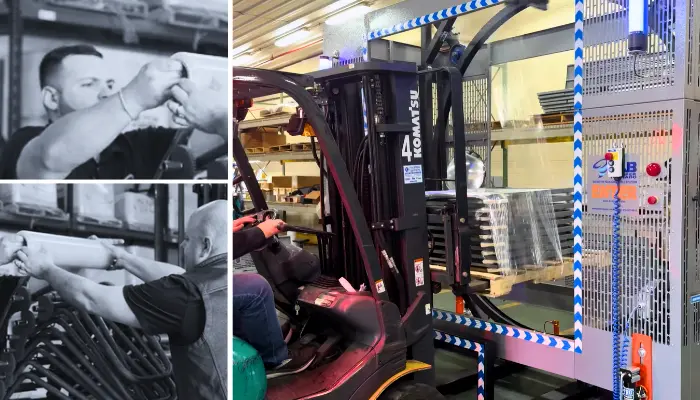
Efficiency is hard-won in modern metal manufacturing shops. Millions of dollars are routinely poured into state-of-the-art CNC plasma cutters, high-speed fiber lasers, automated press brakes, and robotic welding cells so key metal products can move through production lines quickly.
That is, until it all comes to a grinding halt at the wrapping station.
Amidst the maze of automated machinery are two skilled employees walking circles around a pallet with a roll of stretch wrap in hand, trying desperately to get enough tension to secure hundreds of pounds of sharp, shifting metal components.
It doesn’t have to be this way. Manual wrapping used to be the default solution for finishing pallets, but as production speeds accelerate and the industrial labor market remains tight, manual wrapping is a costly operational bottleneck. And for heavy, awkward metal products with sharp edges and protective oils, hand wrapping leaves your throughput vulnerable to freight damage and your team at risk of injury.
The reality is that your state-of-the-art production line is only as fast as your staging area. When forklifts are forced to idle because a human being is still hand-tensioning plastic around a complex load, your packaging method is actively capping your plant’s true capacity.
The clues are already on your shop floor. Here are five signs that your facility is ready to make the switch to automated wrapping.
1. You’ve Hit a Tipping Point with Manual Wrapping
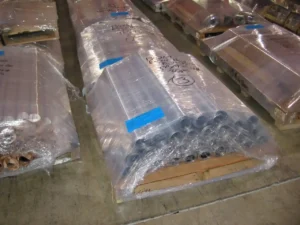
How many pallets justify an investment in an automated wrapper? While there’s not always a precise pallet count that applies to every operation, we commonly see metal fabrication and manufacturing customers begin struggling somewhere in the range of 10 to 30 pallets per shift when relying strictly on manual wrapping.
The challenge isn’t just the pallet count alone, but the combination of heavier loads, inconsistent pallet sizes, long material lengths, and the physical fatigue associated with hand wrapping.
Automated wrapping systems can process these loads in a fraction of the time, effortlessly stabilizing difficult loads – all without adding to your headcount.
2. Idling Forklifts and Congested Staging Areas
“We’re at capacity” is rarely just a verbal complaint from a shipping supervisor; it’s a physical traffic jam on your warehouse floor. Unwrapped, unstable metal loads accumulating in your staging area create a downstream effect that paralyzes other valuable assets and processes. Forklifts idling on the dock means their drivers are waiting around for that manually wrapped pallet.
This mismatch creates a critical vulnerability: the physical speed of your shipping team dictates the true capacity of your entire business, completely capping the ROI of your upstream machinery.
Automating the process slashes your wrapping cycle down to under a minute, instantly clearing out shipping dock congestion and matching the blistering pace of your production line. Forklift operators can rapidly secure loads and load trucks without missing a beat, turning your staging area back into a fluid transit zone rather than a storage bottleneck.
3. Valuable Labor is Pulled Away from High-Value Tasks
Skilled labor in the metal manufacturing sector is at an absolute premium. Finding dependable team members who can weld, operate sophisticated CNC machinery, program lasers, or manage quality control is increasingly difficult and expensive.
When you require these same valuable team members to stop what they are doing to manually wrap pallets for hours each day, you are actively burning high-value labor on low-value tasks. Your workers should be focused on building and moving your products, not walking in circles wrapping them.
Facilities that transfer the grunt work to an automated machine can effectively redirect labor toward advanced material handling, machine operation, welding and fabrication, and quality control.
4. Inconsistent Wrap Quality
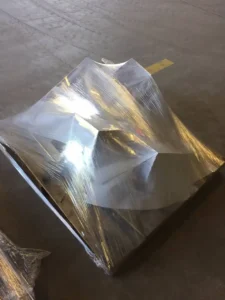
Hand wrapping difficult loads of metal is a tiring job. It will come as no surprise that the first wrapped pallet of the shift will look a lot different from the last one.
Physical fatigue directly leads to inconsistent film tension and poor load containment. Sharp edges on sheet metal or heavy steel castings will easily puncture or slice through loose, poorly applied stretch film. When your loads telescope or shift during transport, you’re left with the ultimate nightmare: returned shipments, rejected deliveries at the customer’s dock, expensive freight claims, and severely damaged client relationships.
Automated wrapping systems eliminate the human variable by delivering exact, computer-controlled film tension and uniform layer overlapping every single time. The right film combined with machine-applied containment, neutralizes sharp metal edges and locks heavy components securely to the skid, virtually eliminating in-transit damage and costly freight claims.
5. Safety Red Flags are Rising
The sheer weight and structural nature of the materials handled daily require strict adherence to ergonomic and protective standards. Yet, manual hand-wrapping is one of the most hazardous tasks still performed on the warehouse floor.
The physical act of manual wrapping requires a worker to constantly bend down while carrying a heavy roll of film, pull tightly with their upper body, and walk backward in a high-traffic environment filled with moving forklifts. This is a primary trigger for musculoskeletal strain, lower back injuries, and repetitive motion claims.
Implementing automated wrapping equipment removes employees from these hazardous physical maneuvers, dramatically reducing the risk of costly workers’ compensation claims. And with advanced safety features like built-in proximity scanners, safety fencing, and automatic cut-offs, the machine safely isolates your team from mechanical hazards, aligning perfectly with a modern, zero-incident safety culture.
What Level of Wrapping Automation Do You Need?
Do these five signs sound familiar? Then it might be time to consider automated wrapping solutions. Before you rush out to buy the biggest, most complex system on the market, it’s essential to consider your needs. Automation is not a one-size-fits-all solution, and a rushed decision can introduce new bottlenecks if it doesn’t match your layout.
A consultative approach is required to properly audit your shipping department. At TAB Wrapper, we work with you to identify the precise level of wrapping automation your metal manufacturing plant requires by evaluating several key operational variables:
- Daily pallet and bundle volume: Assessing current output alongside your 3-to-5-year facility growth targets.
- Load dimensions and weight variability: Analyzing your product mix—whether you ship uniform, standard pallets or a complex hybrid of extraordinarily long tubes and ultra-heavy structural shapes.
- Product stability requirements: Understanding how your metal components behave during transport and the specific containment forces required to prevent shifting.
- Facility layout and forklift traffic: Mapping the physical movement of your equipment to ensure a machine integrates seamlessly into your current footprint without disrupting the flow.
- Current labor involvement: Auditing how many workers are currently being pulled away from the fabrication line to wrap, and calculating exactly how much high-value labor time can be reclaimed.
- Shipping pace and peak production periods: Mapping out your daily shipping cycles. Do your shipments go out steadily all day, or do you experience massive, high-stress surges at the end of a shift that cause a sudden bottleneck?
Based on this assessment, we can confidently determine what style and scale of system makes sense, whether it’s a standard model, fully automated system, or something in between.
Fix the Bottleneck
If your forklifts are waiting, your staging areas are cramped, your skilled workers are walking in circles, and your freight claims are ticking upward, your plant is sending a clear, undeniable signal. Don’t let your packaging process hold back your production potential.
Want to see how automated wrapping works with your specific products before committing? Schedule a free demo with us.