
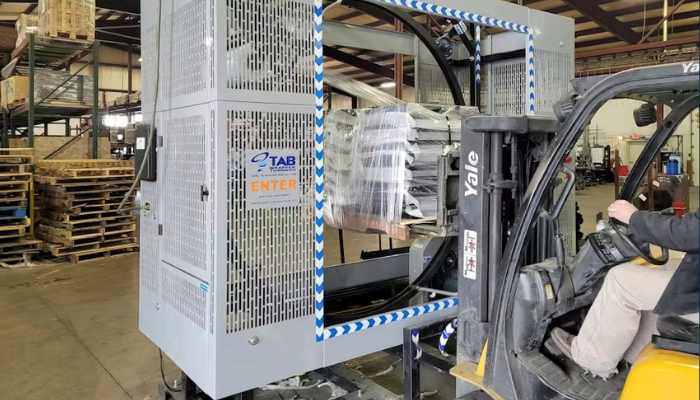
When manufacturers shop for wrapping equipment, conversations usually start with throughput, film cost, and labor savings. But as more facilities automate the last step before a pallet leaves the dock, safety features deserve an equal look. An automated wrapper that runs faster but exposes operators to new hazards, or that shuts down the whole line every time something trips, isn’t actually solving the problem.
A recent Control Design article, written by systems integrator Len Crawford of Maverick Dynamics, gives an inside look at how the TAB Wrapper Tornado line was engineered from the ground up with safety as a design requirement, not an add-on.
Safety Scales With Automation, Not Against It
One of the more useful takeaways from this feature of our TAB Wrapper models is that there is no trade off between safety and automation level. TAB Wrapper Tornado’s controls follow an à la carte philosophy: customers can start with a straightforward push-to-start wrapper and add automation as their needs and budget grow. This is built into three distinct control tiers, each with its own safety architecture appropriate to how the machine is used.
Standard Controls
The entry-level tier uses a single-phase, across-the-line starter and straightforward hardwiring. It’s a reliable, no-frills option for operations that don’t need advanced automation but still want a dependable, well-built machine.
Smart Controls
The Smart tier replaces the basic starter with a variable frequency drive (VFD) that automates the wrapping and film-cutting cycle. Safety functions are managed by a dedicated safety relay working alongside a safety controller, which the article identifies as IDEC components supporting machine safety ratings up to Category 4 and Performance Level (PL) e, the higher end of the internationally recognized scale for how reliably a safety system detects a fault and brings a machine to a safe state.
Genius Controls
The automated Genius tier adds a programmable logic controller (PLC) and a touchscreen human-machine interface (HMI) on top of the Smart tier’s safety foundation. This level supports integration with barcode scanning, lift-and-rotate tables, label applicators, and load-measurement systems, along with specialized wrapping sequences for automated storage and retrieval systems.
What’s Actually Keeping Operators Safe
Behind the tier names, there are additional safety hardware features worth understanding before you buy your TAB Wrapper:
- Emergency stop switches are wired directly into the safety system so the machine halts immediately when triggered.
- Laser safety scanners that watch defined zones around the machine and signal the safety controller the moment a person or object enters, using output signal switching device (OSSD) connections built for safety-rated communication.
- Safe torque off (STO), which removes power from the drive the instant an unsafe condition is detected, without shutting down the rest of the control system. That means less time waiting for a full restart after a routine stop.
- Pre-certified safety logic, configured through DIP switches rather than custom-written and separately validated safety software. The article notes this removes the need for an expensive safety PLC platform and the software audit that typically comes with it, which keeps both the upfront investment and the ongoing complexity down.
Why Diagnostics and Support Are a Safety Issue Too
A safety system only helps if people can act on what it tells them. There are a few other things TAB Wrapper Tornado owners can lean on when something needs attention:
- Fault information tied to specific error codes for components like the safety scanner and safety relay, so a technician knows whether to clean a lens, check a photoeye, or look for mechanical damage, rather than guessing.
- TAB Wrapper University, a video-based training library that lets operators and distributors troubleshoot and adjust the machine on their own, without waiting on a specialist.
- Free global technical support from the controls vendor, on top of TAB’s own support, for issues that do need a second set of eyes.
With more than 2,000 machines in the field, remote access has rarely been needed over the past decade, a sign that the built-in diagnostics are doing what they’re supposed to.
Questions to Ask Any Orbital Wrapping Vendor in 2026
Whether you’re comparing TAB Wrapper Tornado to another option or simply building a purchasing checklist, a few questions separate a genuinely safety-engineered machine from one where safety is an afterthought:
- What safety category and Performance Level is the control system rated for, and does that rating come from a recognized industrial safety vendor?
- Can the automation level be scaled up later without replacing the entire safety architecture?
- What happens operationally when a safety scanner or e-stop is triggered? Full shutdown, or a faster, more targeted response like safe torque off?
- What training and diagnostic resources are available to your team on day one, and a year from now?
Built for Safety, Built in America
TAB Wrapper Tornado machines are designed and manufactured at TAB Industries’ headquarters in Reading, Pennsylvania. Pairing that manufacturing with a safety architecture reviewed in detail by an independent controls publication gives operations leaders, engineers, and safety managers something more concrete to evaluate than a spec sheet alone.
Want to see how the safety-rated controls behind the TAB Wrapper Tornado fit your operation? Explore the TAB Wrapper Tornado lineup or talk with a TAB specialist about which control tier matches your automation goals and budget.