
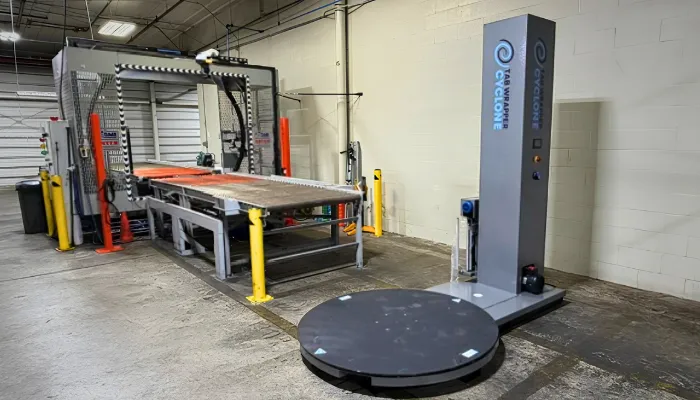
You’ve looked at your outbound pallets and decided a turntable wrapper makes sense for your standard, uniformly stacked loads. Now comes the important part: Where will your TAB Wrapper Cyclone go? What does it need? And what must happen before delivery day?
A little upfront planning means your new machine can start wrapping on day one, not waiting on an electrician, floor repair, or a forklift route nobody mapped out. Operations managers, facilities teams, and plant engineers – this checklist is for you.
Every plant is different, so treat this TAB Wrapper Cyclone readiness guide as a starting point and bring your questions to us. We’re happy to walk through your layout with you.
1. Start With Your Load, Not the Machine
Before you measure floor space, measure your product. Pull the tallest, widest, and heaviest finished pallet you ship, fully built, including any overhang. Then compare it against the machine’s limits.
The Cyclone handles loads up to 50″ x 50″ x 98″ and 4,000 lbs, with a 20″ film width. If most of your pallets fall comfortably inside that envelope, you’re in good shape. If a few of your loads are long, heavy, or oddly shaped, those are better suited to an orbital wrapper, and it’s worth knowing that now rather than after installation. Our size calculator can help you check, and our post on orbital vs. turntable wrapping explains which loads belong where.
2. Map the Footprint
The Cyclone’s turntable is 59″ in diameter. That low profile allows a forklift to load it directly, though a ramp will be required if you’re loading with a pallet jack — an add-on option offered by TAB Industries. But the turntable is only part of the footprint. Keep in mind that the turntable is only part of the footprint. You also need room for the film carriage mast, the touchscreen control panel, the loading ramp if applicable, and clearance on all sides so equipment can approach and operators can stay safely out of the rotating zone.
A simple trick: outline the footprint on the floor with tape, then run a loaded pallet jack or forklift through the approach. If the turn is tight on paper, it will be tighter on a busy shift.
3. Plan the Traffic Flow
Think about the full path of a pallet: where it’s built, where it queues, where it gets wrapped, and where it waits for the truck. The best spot for a wrapping station is usually between final assembly or packaging and the shipping dock, so wrapped loads move forward instead of crossing picking or production traffic.
At up to 20 loads per hour, a Cyclone can keep pace with a busy line, so give pallets a place to stage before and after the wrap. Nothing slows a wrapper down like a full discharge area.
4. Check the Floor
A turntable wrapper carries the full weight of the pallet while it rotates. Look at the condition and levelness of the slab where you plan to install it, and note any cracks, patches, or expansion joints near the footprint. To properly secure the wrapper to the floor, we recommend using ½″ x 6″ long lag bolts.
5. Confirm Power and Utilities
This is the item most likely to cause a delay, so check it early. Identify the nearest panel or outlet to your planned location and measure the distance. We provide a detailed electrical schematic of the wrapper at the time of purchase; sharing those schematics with your electrician before delivery will make it much easier to get any required wiring finished ahead of time.
6. Plan Your Film Supply
The machine is only as good as the film running through it. The Cyclone’s adjustable film stretch (20% to 150%) lets you dial in tension for each load, but you’ll need rolls on hand when you start. Decide where you’ll store film near the station, how many spare rolls you’ll keep, and who’s responsible for reordering. Not sure which film fits your product? Start with our guide to choosing the right stretch film.
7. Think Through Safety and Training
The Cyclone’s photo eye sensor reads load height and lets the operator step away during the wrap cycle. That’s a real efficiency gain, and it’s also a reason to define the work area clearly. Mark the perimeter on the floor, decide who is allowed to operate the machine, and schedule training for every shift that will use it. A touchscreen with real-time diagnostics helps new operators get comfortable quickly, but a 15-minute walkthrough at the machine goes a long way.
8. Prepare for Delivery Day
A few last details to settle before the truck arrives:
- Confirm dock or door width and the route from the receiving area to the install spot.
- Have a forklift available to offload and position the machine.
- Make sure power is ready, and the footprint is clear.
- Schedule operator training and a few test pallets right after installation.
- Choose a time outside your busiest shipping window.
We want you to feel confident about the delivery of your TAB Wrapper Cyclone. Give us a call at (610) 921-0012 – our team is happy to answer your questions.