
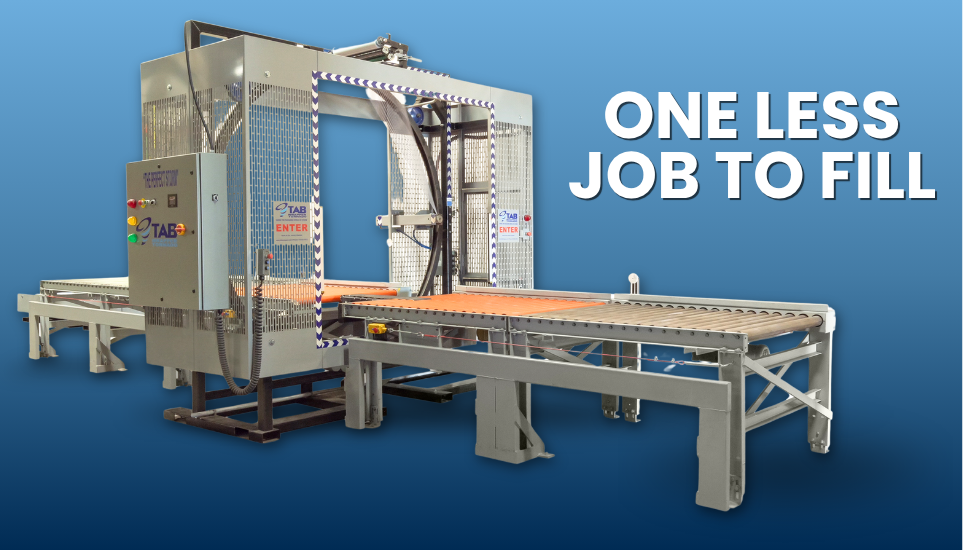
You can’t hire fast enough, and some of the people you already have are spending a chunk of every shift walking film around pallets by hand. You probably can’t hire your way out of a wrapping bottleneck right now. But you may not have to. The wrapping station may be the one place you can give people back to the floor without hiring anyone at all.
The Hidden Headcount Cost
Hand wrapping never shows up as its own line item on a P&L. There’s no budget code for “two people standing at the end of the line wrapping film around pallets all day.” But the cost is real, and it’s paid every single shift.
Do the math on your own floor for a second. If it takes two people roughly five minutes to hand-wrap one pallet, which is a pretty typical pace, and you’re moving 60, 80, 100 pallets a day, you’re not spending a few minutes on wrapping. You’re spending hours of combined labor every day on a task that adds zero value to the product itself. It doesn’t make anything. It doesn’t fix anything. It just has to get done before the truck leaves.
Then there’s the end-of-day rush. Orders pile up, the delivery deadline doesn’t move, and now you’re paying overtime to get pallets wrapped and out the door. When people are rushing to hit a cutoff, wrap quality slips, too loose in some spots, over-wrapped and wasteful in others, and that inconsistency comes back later in the form of shifted loads and freight damage claims.
None of this shows up as “wrapping is expensive” on a report. It shows up as overtime, a backlog of orders that need to be rushed, and two of your best people never available for anything else because they’re stuck at the wrapping station.
What You Get Back When You Automate the Step
The point isn’t to wrap pallets better. It’s to stop burning labor hours on wrapping pallets altogether, so your team can do the work that actually can’t be automated, such as running equipment, inspecting quality, keeping paperwork moving, and building the next order.
A few examples of what that looks like in practice:
Oregon Powder Coating, a metal finishing shop in Tangent, Oregon, was running a manual wrapping process that needed 2-3 workers and roughly 5 minutes per pallet, sometimes longer for irregular shapes. After switching to an orbital wrapper, that dropped to a single-person process, with wrapping time cut from over 5 minutes down to under a minute per pallet. The employees that freed up didn’t sit idle; they moved into part production, quality inspections, and paperwork.
City Pipe & Supply, a pipe, valve, and fitting distributor in Odessa, Texas, used to have two people struggling to hand-wrap 80 pallets a day. With one operator and an orbital wrapper, that team now ships out an average of 150 pallet loads a day, almost double the volume, with half the people. Recurring overtime disappeared, and the order backlog shrank right along with it.
Macksteel, a metal fabricator in Watertown, South Dakota, saw one of the starkest before-and-afters: one person now wraps a pallet in about 15 seconds, compared to two people taking five minutes the old way. That’s not a modest efficiency gain; that’s an entire second employee no longer needed at that station all day.
Same story, three different industries. The wrapping step didn’t get more sophisticated. It just stopped requiring a second (or third) person standing there doing it. You can browse more results like these on our case studies page.
The Job Nobody Wants
There’s a retention angle here too, and it matters more right now than it used to, because every hire is hard to replace.
Hand wrapping is, by a wide margin, one of the least popular jobs on a warehouse or shop floor. It’s repetitive, it’s physically uncomfortable, with a lot of bending and reaching under raised pallets, and it’s usually the task people are handed as an afterthought rather than something anyone signed up for.
City Pipe’s VP put it bluntly. Nobody on his team enjoyed doing this job, and once they automated it, nobody wanted to go back to wrapping by hand. Over at Oregon Powder Coating, the change was just as clear. The operators who once dreaded the manual process now say it’s far easier, and none of them would want to go back to doing it manually. Employee complaints about back soreness from the old process stopped entirely.
Automating the least-liked job on the floor is a quiet way to make the jobs you do have easier to keep filled. It’s a small thing to point to in an exit interview, but it adds up when you’re fighting to hold onto every hire you’ve got.
(Worth a brief mention: there’s also a real safety upside here with fewer repetitive-motion injuries, fewer cuts from film cutters, but that’s its own conversation. We covered it in more depth in our post on wrapper safety features)
How It Works
If you haven’t seen an orbital stretch wrapper in action, the mechanics are simple. A forklift operator drives the pallet load into a stationary ring, presses start, and stays in the seat the whole time. The machine wraps stretch film 360 degrees around and under the pallet automatically, then cuts the film when it’s done. No one has to walk around the load, pass a roll back and forth, or reach underneath it.
And it’s not all-or-nothing. You can start with a push-to-start setup that still needs an operator’s hand on the button, or move all the way up to semiautomatic Smart Controls that run the whole cycle with a wireless remote. Start with the option that fits your floor and budget today – you can always add on more automation later.
Wrapping FAQs
How much labor does hand wrapping actually cost per pallet?
More than shows up on any report. A typical pace is two people at about five minutes per pallet, so at 80 or 100 pallets a day you’re burning hours of daily labor on a task that adds no value to the product. Our ROI calculator will size it for your floor.
Can one person operate an orbital wrapper, or does it still take a team?
One person. The forklift operator drives the load into the ring, presses start, and stays in the seat. At City Pipe & Supply, one operator now ships 150 pallets a day, versus two people hand-wrapping 80.
Will automating pallet wrapping let me reassign workers instead of laying them off?
That’s how most short-staffed operations use it — freeing people for work that can’t be automated. When Oregon Powder Coating dropped to a one-person process, those employees moved into part production, quality inspections, and paperwork.
Do I need a fully automated system, or can I start smaller and scale up?
You can start smaller. The TAB Wrapper Tornado is à la carte, so you can begin with a push-to-start setup and add automation later, up to a fully automated Perfect Storm model. You pick the level that fits your floor today.
The One Place to Solve Your Staffing Problem Without Hiring
You’re not going to fix your staffing problem everywhere at once. But the wrapping station is a rare exception: it’s a spot on the floor where you can free up a person (or two) without posting a single job listing.
If you want to see what that actually looks like with your own crew and your own loads, we’ll run a free demo on your floor, no obligation. And if you want to run the labor-cost math yourself before that conversation, helpful timing, with September budget season coming up, our ROI calculator will do it for you.